


Meet the Artists of Macbeth: A Student & Teacher Story
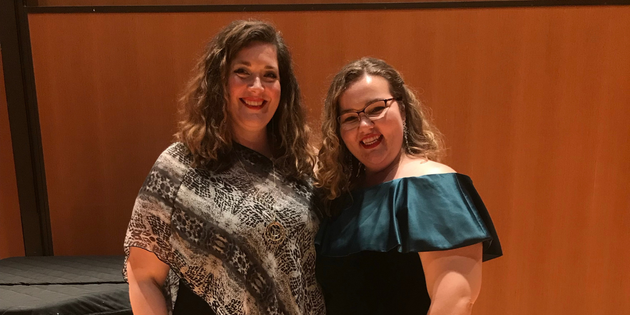
When you see artists on stage embodying commanding roles like Macbeth and Lady Macbeth, it’s the result of decades of work. Every opera singer works with countless instructors in voice lessons, masterclasses, coaching sessions—each building their skills bit by bit. At Macbeth, you get to see something really special: a student and teacher sharing the stage. Marcy Stonikas, our Lady Macbeth, taught Emily Thompson, our Resident Artist playing the 2nd Apparition at the Florida State University. As you’ll learn in our interview, Marcy served as both teacher and career model for Emily, and this experience coming together for Macbeth is beautifully full-circle.
Opera Colorado: Tell us about the history of your relationship as student and teacher.
Emily Thompson: Marcy joined the faculty at Florida State University at the same time I started my freshman year there. She wasn’t my original private teacher, but I specifically remember Marcy going out of her way to meet the students and show them she was there as a support system, source of information, and advocate even if she wasn’t your private teacher. So from the start, I thought she was really wonderful.
Marcy was the first voice teacher I’d ever known who I could see myself in vocally, because I’d never had a teacher whose voice sounded like mine.
I’ve had a big voice since I was a kid, and my teachers would tell me that I was too young for my voice, or that my voice wasn’t made for right now. Then at the end of my sophomore year, I dealt with a vocal injury and I thought I needed to be hearing from someone who knows what this should feel like, so I requested to switch into Marcy’s studio and she became my biggest cheerleader, a friend, and someone I admire to this day—and the rest is history.
Marcy Stonikas: Literally. History in the making, right?
ET: Yes!
MS: I have a very similar recollection to Emily. I was very new to teaching in academia when I started there—it was my first teaching position at an academic institution, as I’d only taught privately until that point. As a singer myself, I was thinking about what was important for me to pass on to anyone with whom I was working, and I try to really hold true to that to this day. It’s not my job to decide whether you belong in the industry, it’s my job to help guide and support your dreams, your voice, and your growth. When you come into a school as an undergraduate, your voice is not mature at all yet, and that can’t really be said for other instruments.
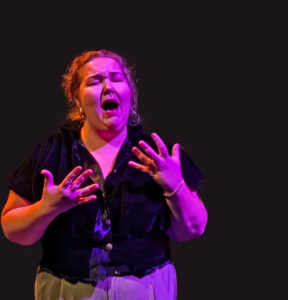
I always had my eye on Emily because I saw in her, for lack of a better term, a “baby me.” I really wanted to make sure that she knew I wanted to support her and help her succeed. I also wanted to make her feel valid and that there was a place for her. It’s unavoidable to feel a bit like a black sheep, or a bit like you stick out when you have a bigger voice, especially at a very young age, like Emily.
So when I was asked to take her into my studio, I was over the moon. To have the opportunity to work with somebody who has a similar voice or fach is so meaningful.
At Emily’s age, it was hard to tell exactly how her voice would develop, but I guessed pretty accurately. I just started assigning her stuff that I had either sung or wanted to sing when I was her age. That’s what happened for both her junior and senior recitals. And starting our time together with a vocal injury, that’s difficult for a lot of reasons, but also because there’s a kind of stigma around them, but what Emily experienced was not completely serious and she was about to get over that hurdle almost immediately, particularly with attention and mindfulness, which Emily has in spades, because she’s an exceptional musician. She’s not just a singer, she plays piano, she’s just so smart on top of being talented. She was a dream student in every single manner of speaking because she worked hard, took singing seriously, wanted to work with me, and always showed up prepared and willing to try things. I cried for probably a month straight when she graduated, because we’d talked about the idea of her potentially staying at FSU for a master’s, since we’d only worked two years together. There were a bunch of extenuating circumstances that led us both to agree it was probably not the best idea, so I sent her off to somebody that I felt could best continue Emily’s trajectory.
OC: You two went to the same graduate school, right? Roosevelt University?
ET & MS: Yes.
MS: Exactly, I sent her where I’d done my grad school training and I think that was a good choice. It was important to me because I knew she would be accepted there since I went there, so I felt confident about things working out for Emily.
OC: Thank you both—you have wonderful things to say about each other! How would you go about describing your voice types?
MS: I think it’s still kind of up in the air for Emily. She’s probably a dramatic soprano, or what we’d call a “baby dramatic soprano.” I don’t know what I would classify myself at this point. I’m a big voice soprano, and I sing a lot of Strauss, Wagner, and big Puccini. Singing this Verdi [Lady Macbeth] is one of the bigger soprano roles. I think the most important distinction to be made when classifying ourselves in this way is thinking about the tessitura that we sing in. For other soprano Fachs, it typically is a smaller range than the one that Emily and I find ourselves comfortable singing. We kind of sing the gamut, and for example, in the role of Lady Macbeth, which I am debuting at Opera Colorado, I sing quite low, but also quite high, and everywhere in between. I have long, sustaining phrases, but also a lot of fast-moving coloratura passages. Because of all of that, it’s difficult to really classify us beyond “big voice sopranos.”
OC: Thank you for clarifying. You’ve touched on this a little, Emily, but could you speak a little more about how Marcy affected the trajectory of your career?
ET: Working with Marcy and the stuff I learned not only helped me grow, but it was also a huge relief for me. Like we’ve touched on, I was someone with a big voice right away. When I was a kid, teenager, college student—huge voice. Throughout that time, it felt like people always had to make sure that I knew my voice was the odd one out. Over time, it made me feel like I couldn’t do anything—I had to sit there and wait around for my voice to suit me. I didn’t know what it was meant for or what I could do with it, and despite working with a lot of wonderful teachers prior to Marcy, none of them could really tell me how I should feel while singing. With Marcy, I learned how my voice was supposed to feel in my body and how sometimes an instrument like mine makes you feel wild and intense on the inside. She affirmed for me that yes, this is what my voice can do now, and what my voice will do later. I learned that I didn’t have to avoid repertoire that felt good because I haven’t reached the right age yet.
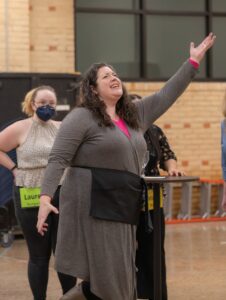
Marcy also helped me see that sometimes things take time. She was almost thirty at her first Young Artist residency, and that instilled in me the idea that you can show up as an artist and be your best self without rushing the process. You can be patient and step up to the plate and accept your voice for what it is at the same time. This helped me during and after grad school, when I didn’t have a lot going on. I would tell myself, “No, I’ve learned this lesson already,” and that I cannot begrudge the things that haven’t come to me yet. I could not blame myself and my instrument. All I could do was work hard and try to be the best, most authentic artist I could be, and that has to make me proud, you know?
Another thing I got out of working with Marcy was seeing someone be authentic and unapologetically themselves anytime they walked into a room.
Seeing the caliber of artist she is at the same time really dispelled a lot of assumptions I had about the opera industry. As classical voice students, we’re told a lot of things about the business when it comes to people’s attitudes, how good you have to be, all the competition… What I saw in Marcy was that the industry, for the most part, is great people who want to tell great stories. I learned that if those people aren’t in the room, you don’t want to work there. I felt encouraged to show up and be a good colleague as well as a good artist, and I learned that from her example. I wasn’t feeling as sure about the opera industry in college. Things get stressful and you don’t always know your place before you’re in it, but having an example like her—even when she wasn’t my teacher—really made me want to do this more. It made me want to be a good person making good music telling good stories that move audiences.
OC: Moving to something a little different, Marcy, you are one of the only people in the Macbeth cast who is not making their Opera Colorado debut, since you made your debut two years ago as Senta in The Flying Dutchman. Could you describe your experience here?
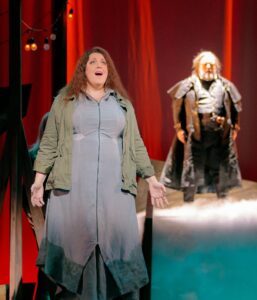
MS: I have nothing but positive experiences from my Opera Colorado debut. There were several people on the creative team of The Flying Dutchman who I already knew, so it’s always a small world the longer you’re in this business. It felt really comfortable from the get-go, and there’s a warmth at the company that was immediately obvious to me. But also, my husband’s entire immediate family lives in Denver, so I knew the area, I’d been many times previously, so it was nice on multiple levels. Feeling comfortable and having a knowledge of the city outside of the opera company was really positive. Being alone in a hotel room every night can be really hard, and I was fortunate to be able to spend time with family when I wasn’t in rehearsal or studying my score. It was kind of the best of both worlds, where I got to do my favorite thing (performing) and had something to do outside of rehearsal.
OC: We’re so glad you had such a good experience. And Emily, did you know that Marcy had performed here before applying to our Artist in Residence Program?
ET: Yes, I knew she had performed here and I knew some of the people. Some of the staff here came from Seattle Opera, where Marcy had performed a lot, and the fact that she was coming back to Opera Colorado for Macbeth spoke really highly about the leadership. Knowing that people I look up to and respect as an artist and a peer work at these companies was only a good sign to me. And even just starting here two weeks ago, I’ve felt nothing but warmth. Everyone wants to be supportive and make sure that the other Resident Artists and I feel comfortable and excited to be here, and it’s been really wonderful.
OC: That’s great to hear—we do love our Resident Artists! Marcy, this is your role debut for Lady Macbeth and you’ll be playing the Lady-in-Waiting at the Met around the same time, so two different experiences with Verdi’s Macbeth this fall. What does this opera mean to you?
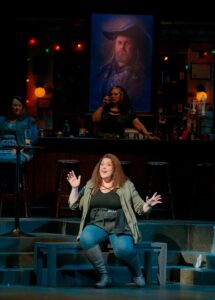
MS: This is my first time singing Verdi roles in this capacity, and it’s something I have wanted to do for quite some time. It’s definitely the preferable order of doing these roles, by the way, because if one is to sing Lady-in-Waiting and Lady Macbeth, it’s better that Lady Macbeth is last! It’s been great to be in the room at the Met, watching and listening to other artists hone their craft, especially without having the stress of being a lead. It is my first time singing the role, so I’ve gotten this extended runway to feel acclimated to the world of Macbeth.
As a play, it’s a compelling work of art already, but it’s always interesting for me to try to figure out where I think my role fits into all of that, and how I can bring myself to make each character as three-dimensional as possible, which I strive to do as an artist. The easiest way for me to do that is by figuring out what I have in common with the role I’m playing. So with Lady Macbeth, that can seem challenging, because they are doing some rather dastardly stuff, like manipulation and violence.
I find that when it comes down to it, this is a psychological thriller about ambition, and I can certainly relate to ambition. I think we all can, and it’s one of the ways this story has remained relevant. Even if I wouldn’t have acted in the same manner as Lady Macbeth, can I relate to feeling like this in some other capacity? The answer is usually yes.
OC: How does Verdi’s music connect to the drama for the audience?
ET: Verdi is classic. You get the big show, big sound, romantic sweeping lines in the orchestra for the singers… when I want to listen to capital-O “Opera”, I listen to Verdi. I think that’s really attractive not just to people who know and love opera, but also to people who hear we’re doing Macbeth and think “I know the play, what’s this about?” Then, they come in and they hear the kind of sound, the fabulous music and production—I think it’s attractive to them too. Aside from the surprisingly relatable parts of the story of “is this fate, and is it in my hands?”, Verdi’s music is good for everyone.
MS: Such good music. It’s interesting and comical, almost, that it’s full of earworms. It’s so singable and catchy, you can’t help but hum it every time you leave a rehearsal or the theater, because that’s Verdi. This opera is no exception, and I find it almost funny because we’re talking about murder, intrigue, violence, lying, and witches and the music can be happy and light at times. You wouldn’t always connect the story with some of the music you’ll hear, but it really works. It speaks to the idea that nothing is one-sided.
Dramatic opera doesn’t have to be just doom and gloom all the time. It can be lush and full, and it’s really interesting in that way.
It makes the moments where there are these grave discoveries hit that much more impactfully because no one sees it coming. I don’t want to say that opera is a soundtrack, but sometimes you can’t help but be emotionally on a journey when you’re hearing certain music—we’re all susceptible to that.
OC: Have you two shared the stage together before? How are you feeling about being in the same cast for Macbeth?
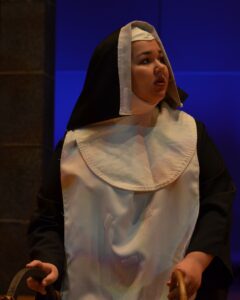
MS: We have not shared the stage before, even though it could have happened at some point, even at FSU, but it just didn’t manifest, so I am beyond excited. Seeing Emily in the Artist in Residence Program at Opera Colorado and knowing that she was in the first round of my students at FSU—it’s like the old guard and the new guard. More than anything, I’m just excited, it’s going to be fun, even though we’re not on stage really at the same time…
ET: No, we’re not at all. In our first week of meetings as the Artist in Residence Program began, people were wondering if any of us knew the principal artists this season. I told them Marcy was my first teacher, and everyone got super excited. It’s very fun. I’m honored to be attached to you in some kind of way.
MS: Oh my gosh, same. Same to you. Forever.